Essential cookies only, Cookie Policy.
Generate strong unique passwords and learn the 5-step verification protocol that stops phishing before credentials are ever entered. Trusted by users who've been targeted, and by those who never want to be.
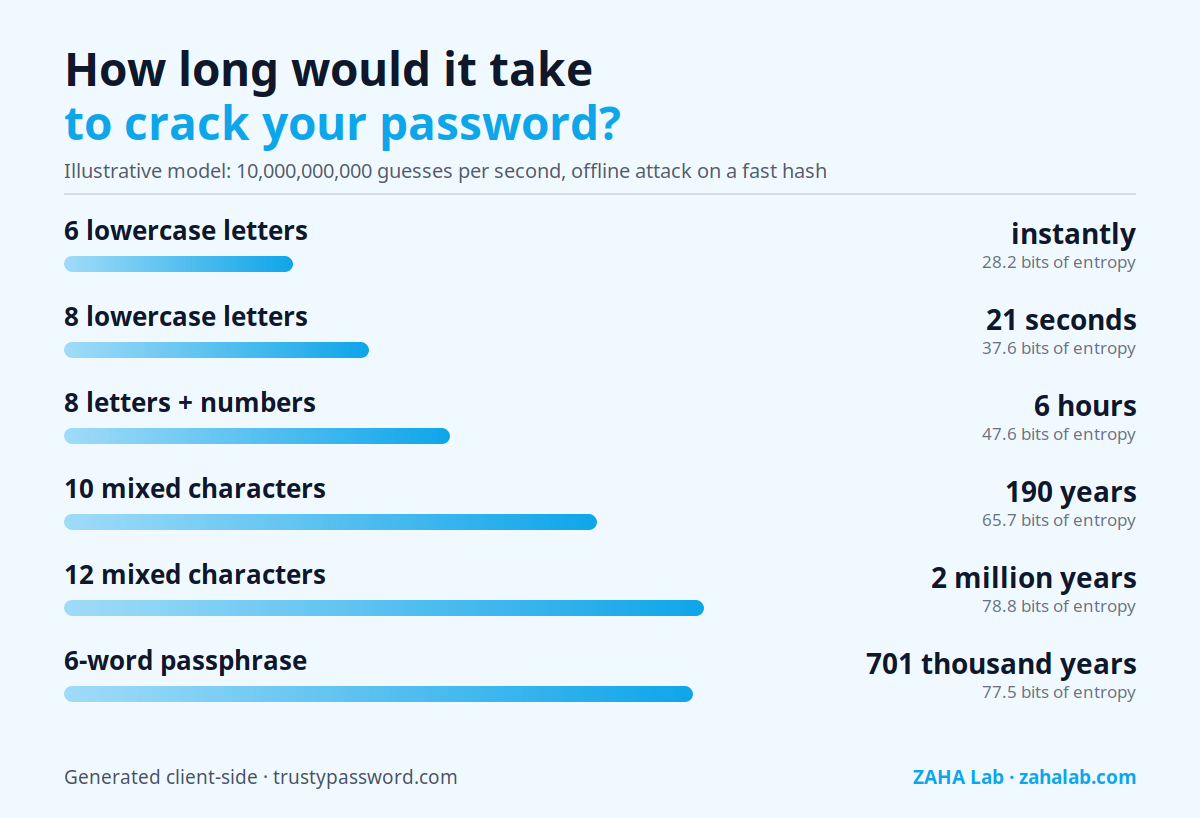
A short password falls instantly, however random it looks. The table and chart below model an offline attack at 10,000,000,000 guesses per second against a fast hash — the same maths a cracking rig actually runs.
| Password pattern | Time to crack | Entropy (bits) | Verdict |
|---|---|---|---|
| 6 lowercase letters | instantly | 28.2 | Weak |
| 8 lowercase letters | 21 seconds | 37.6 | Weak |
| 8 letters + numbers | 6 hours | 47.6 | Moderate |
| 10 mixed characters | 190 years | 65.7 | Moderate |
| 12 mixed characters | 2 million years | 78.8 | Strong |
| 6-word passphrase | 701 thousand years | 77.5 | Strong |
Assumes uniform random characters and no rate limiting. Password reuse or a breach database shortcut all of the above, which is why a unique password per account matters more than length alone.
The Credential Guard addresses both primary attack vectors simultaneously, the unique password defeats stuffing, the verification protocol defeats phishing.
The Am I Safe? checklist teaches the 5 verification steps alongside every generated password, building habits, not just credentials.
Each generated password is unique, a breach of any one site cannot compromise another account sharing a different password.
Store generated passwords in a password manager. Autofill becomes your phishing detector, the manager won't fill on a fake domain.
Learn which MFA methods actually resist phishing (FIDO2) and which don't (TOTP, SMS), a critical distinction most guides miss.
Real-time adversary-in-the-middle (AiTM) attacks can bypass TOTP, SMS, and push notification MFA. Only FIDO2/WebAuthn is categorically phishing-resistant.
| MFA Method | Phishing-resistant | SIM swap-resistant | Why | NIST AAL |
|---|---|---|---|---|
| FIDO2/WebAuthn hardware key | ✓ Yes | ✓ Yes | Cryptographic origin binding, cannot authenticate on wrong domain | AAL3 |
| Passkeys | ✓ Yes | ✓ Yes | Same origin binding, platform-managed | AAL2–3 |
| TOTP authenticator app | ✗ No | ✓ Yes | 6-digit codes forwardable in real-time AiTM attacks | AAL2 |
| Push notification (Duo, MS) | ✗ No | ✓ Yes | MFA fatigue attacks, user approves under repeated prompts | AAL2 |
| SMS OTP | ✗ No | ✗ No | Forwardable + SIM swap + SS7 interception | AAL1 |
| Email OTP | ✗ No | ✗ No | Forwardable + requires email account not compromised | AAL1 |
Source: CISA Implementing Phishing-Resistant MFA · NIST SP 800-63B 2025
FIDO2/WebAuthn hardware security key, the only MFA method that is cryptographically phishing-resistant. Used by Google, the UK government, and GCHQ-affiliated organisations. Works with Gmail, Outlook, GitHub, and most major services.
Shop YubiKey →Independently audited password manager with phishing detection built in, the autofill system is domain-bound and alerts when you visit a site that differs from where credentials were saved.
Try 1Password →End-to-end encrypted email reduces phishing risk from the platform side. Zero-knowledge architecture means email contents are not accessible to Proton even under legal request. Available with custom domain.
Try Proton →Next-generation password manager with zero-knowledge architecture and advanced credential health monitoring. NordPass helps you generate, store, and autofill unique passwords across all your devices with phishing-resistant autofill that only works on the correct domain.
Try NordPass →The guides and Credential Guard on this site are written by Sophie Laurent, our security editorial team who has designed and delivered security awareness programmes for FTSE 250 companies, NHS trusts, and public sector organisations across the UK. Sophie Laurent specialises in translating technical threats into actionable guidance that non-technical employees and individuals can actually apply.
All content aligns with NCSC phishing guidance, CISA phishing-resistant MFA recommendations, and NIST SP 800-63B 2025.
About Sophie Laurent →Specialist password tools for every audience and use case.
crypto.getRandomValues(), the browser's CSPRNG backed by OS hardware entropy. Nothing is transmitted to any server. No passwords are stored by this site. Open DevTools (F12) → Network → Clear → Generate to verify zero requests during generation.